Scientific Notation Converter with Significant Figures
Convert decimals into scientific notation, choose the exact number of significant figures, and see the matching e-notation for calculators, chemistry homework, and lab reports.
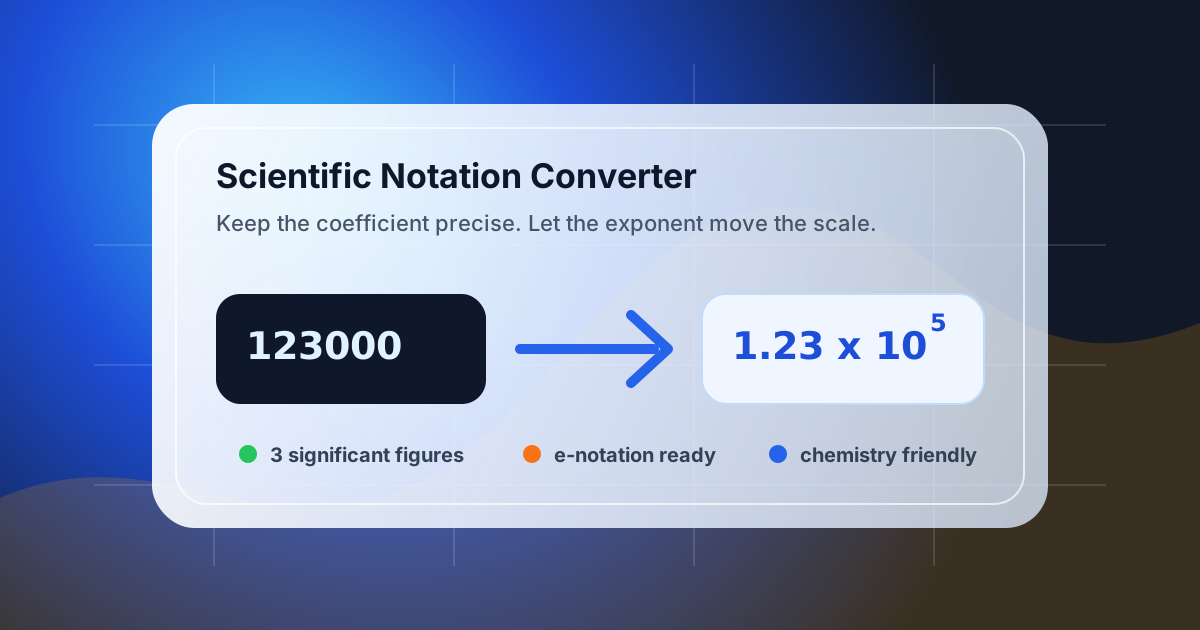
The coefficient carries the significant figures.
The exponent changes the scale, not the precision.
Move the decimal point 5 places to the right to return to standard notation.
What this scientific notation converter accepts
You can enter ordinary decimal numbers, E notation, or typed power notation. The converter keeps the coefficient tied to the significant figures you choose.
A large decimal number converted into coefficient and exponent form.
Leading zeros disappear, while the final zero stays significant.
Typed power notation is normalized into calculator-friendly E notation.
E notation and scientific notation mean the same thing.
Use it for calculator e-notation
Switch between 1.23 x 10^5 and 1.23e+5 without losing the significant figure count.
Chemistry-friendly precision
Trailing zeros in the coefficient stay visible, so 1.00e+3 clearly has three sig figs.
Built for long-tail examples
Use the examples hub to check common questions like 100, 0.00450, and rounding to 2 sig figs.
How to convert to scientific notation
Find the first non-zero digit
This digit starts the coefficient. For 0.00450, the first non-zero digit is 4.
Move the decimal point
Move it until the coefficient is at least 1 and less than 10. For 123000, that gives 1.23.
Count the moves as the exponent
Moving left creates a positive exponent. Moving right creates a negative exponent.
Keep the significant figures
Zeros in the coefficient are meaningful, so 4.50 x 10^-3 has three significant figures.
Tricky scientific notation examples
The coefficient shows whether you mean 1, 2, or 3 significant figures.
The two zeros after 7 stay significant because they are in the measured coefficient.
Rounding carries the coefficient to 10, so the exponent increases.
The exponent is not counted as significant figures; the coefficient has four.
Scientific notation and sig fig rules
Only the coefficient determines the significant figures.
The exponent changes scale, not precision.
Trailing zeros in a decimal coefficient are significant.
Scientific notation removes ambiguity from large rounded numbers.
Scientific notation FAQ
What is a scientific notation converter?
A scientific notation converter rewrites a decimal or E notation value as a coefficient times a power of ten, such as 123000 = 1.23 x 10^5.
How do significant figures work in scientific notation?
Only the coefficient controls the significant figure count. In 4.50 x 10^-3, the digits 4, 5, and the final 0 are significant; the exponent only sets the scale.
Is E notation the same as scientific notation?
Yes. E notation is a calculator-friendly way to write scientific notation. For example, 1.23e+5 means 1.23 x 10^5.
Can I convert scientific notation back to decimal form?
Yes. Enter a value like 3.5e3 or 3.5 x 10^3 and the converter shows the decimal value along with scientific notation and E notation.
Why does scientific notation help with trailing zeros?
Plain whole numbers like 1000 can be ambiguous. Scientific notation makes the precision explicit, such as 1 x 10^3, 1.0 x 10^3, or 1.00 x 10^3.