Sig Fig Rules for Addition and Subtraction
If you've ever wondered why your chemistry teacher marks your answer wrong even though your math was correct, you're in the right place. The sig fig rules for addition trip up students all the time—but once you understand the logic, they become second nature. Let me walk you through it.
The Core Rule: It's About Decimal Places, Not Sig Figs
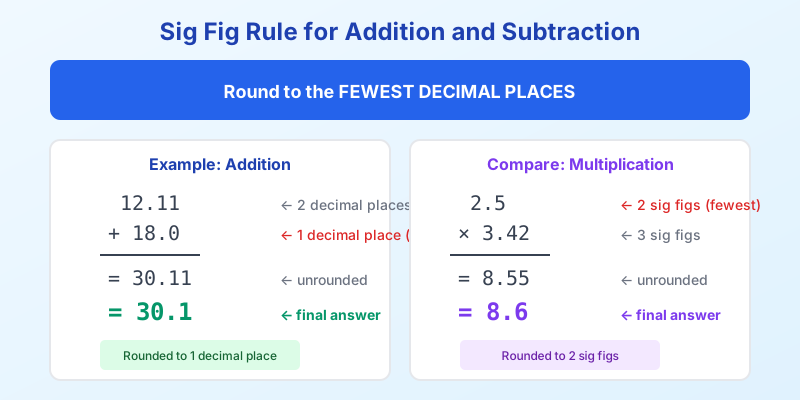
When adding or subtracting, your answer can only be as precise as your least precise measurement—measured by decimal places.
This is different from multiplication/division, which uses sig fig count. For addition and subtraction, count decimal places instead.
Why Decimal Places Matter in Addition
Think about it: if you measure something as 12.5 cm (precise to tenths) and add 3.25 cm (precise to hundredths), your answer can't magically be more precise than your least precise measurement.
12.5 + 3.25 = 15.75
→ 15.8 (1 decimal place)
The 3-Step Process
Do the math normally
Add or subtract all the numbers without rounding
Find the fewest decimal places
Look at all your original numbers. Which has the fewest decimal places?
Round your answer
Round your result to match that number of decimal places
31.123 → 31.1
✓ Rounded to 1 decimal place
Common Mistakes to Avoid
- Using sig fig count instead of decimal places
- Forgetting to count decimal places in whole numbers (they have 0)
- Rounding intermediate steps in multi-step problems
Mixed Operations: What Comes First?
When you have both addition/subtraction AND multiplication/division in one problem, follow order of operations (PEMDAS). Apply the appropriate sig fig rule at each step, but keep extra digits until the final answer.
Related Guides
Decimal Places vs Significant Figures
Why addition uses decimal places
Significant Figures Worksheet
Print addition, subtraction, and mixed practice
Multiplication & Division Rules
Round to the fewest sig figs
Complete Sig Fig Rules
All 5 counting rules
Rounding Sig Figs
How to round correctly
Practice Problems
48 interactive problems