Rounding Significant Figures: Complete Guide
Rounding significant figures trips up a lot of students—but it doesn't have to. Whether you need to round to 3 significant figures for a chemistry lab or round to 2 sig figs for physics homework, this guide on rounding sig figs breaks it down into simple steps you can follow every time.
The Golden Rule for Rounding Significant Figures
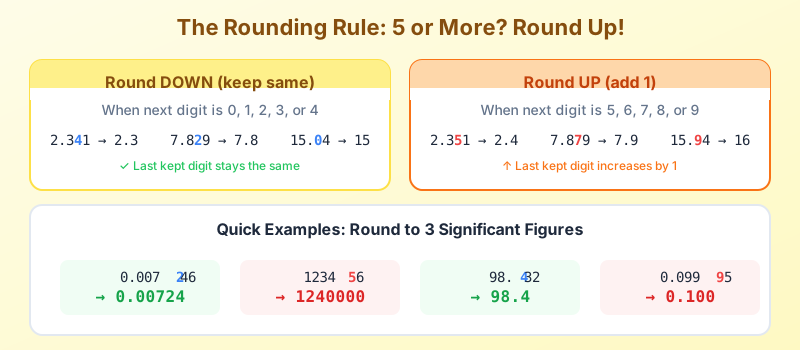
If the next digit is 5 or more, round up. If it's 4 or less, round down.
That's the foundation of rounding sig figs. But knowing which digit to look at—that's where students get confused when rounding significant figures. Let me show you exactly how to find it.
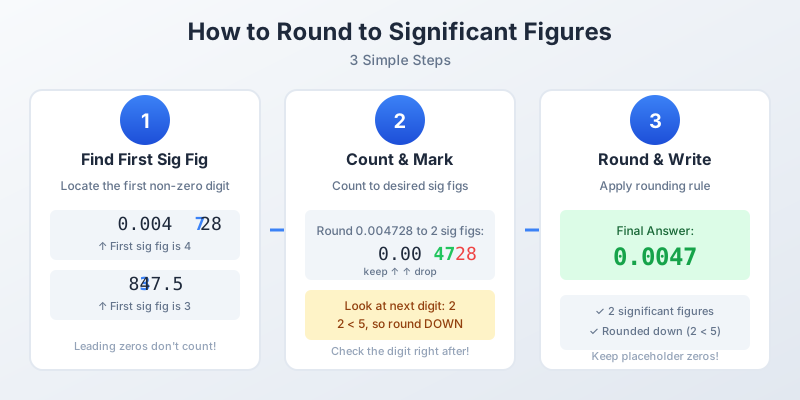
The 3-Step Process for Rounding Significant Figures
Find the First Significant Figure
Start from the left and find the first non-zero digit. This is your first sig fig. Remember: leading zeros never count as significant figures.
Count to Your Target Number
From the first sig fig, count right until you reach the number of sig figs you need. The digit after your last sig fig determines whether you round up or down.
Round 0.004728 to 2 sig figs:
0.004728
Apply the Rounding Rule
If the next digit is 0-4, keep the last sig fig the same (round down). If it's 5-9, add 1 to the last sig fig (round up). Don't forget placeholder zeros!
0.004728 → 0.0047
✓ 2 significant figures, rounded down
Common Mistakes When Rounding Significant Figures
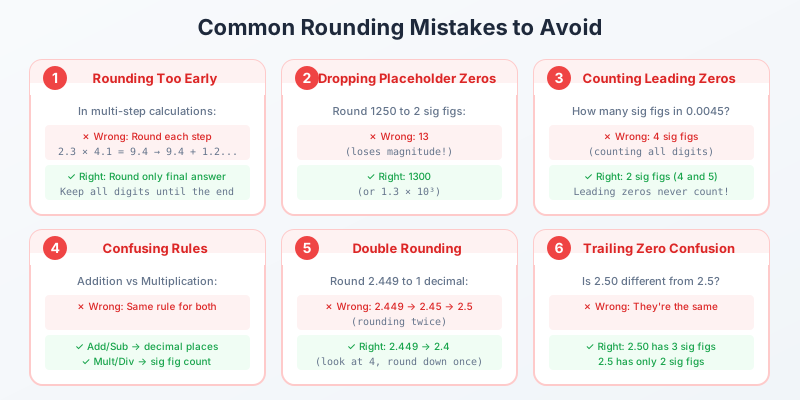
Mistake #1: Rounding Too Early
In multi-step calculations, keep all digits until the very end. Rounding intermediate results causes "rounding error accumulation" and can throw off your final answer significantly.
Mistake #2: Dropping Placeholder Zeros
When you round 1250 to 2 sig figs, the answer is 1300, not 13. Those zeros maintain the number's magnitude. Use scientific notation (1.3 × 10³) if you want to be unambiguous.
Mistake #3: Counting Leading Zeros
Leading zeros (like in 0.0045) are never significant—they just show where the decimal point is. Start counting from the first non-zero digit.
Mistake #4: Using Wrong Rules for Operations
Addition/subtraction uses decimal places. Multiplication/division uses sig fig count. Mixing these up is one of the most common errors.
Mistake #5: Double Rounding
Never round in stages. To round 2.449 to 1 decimal place, look at the 4 (not the 9). The answer is 2.4, not 2.5. Round once, directly to your target precision.
Mistake #6: Ignoring Trailing Zeros After Decimal
2.50 and 2.5 are different! The first has 3 sig figs, the second has 2. That trailing zero tells us the measurement was precise to the hundredths place.
Quick Reference: Rounding Significant Figures Examples
| Original | 1 Sig Fig | 2 Sig Figs | 3 Sig Figs |
|---|---|---|---|
| 3.14159 | 3 | 3.1 | 3.14 |
| 0.007856 | 0.008 | 0.0079 | 0.00786 |
| 12,345 | 10,000 | 12,000 | 12,300 |
| 98.765 | 100 | 99 | 98.8 |
Special Cases in Rounding Significant Figures
The "Rounding 5" Debate
What happens when the digit is exactly 5? Most schools teach "round up" (so 2.5 → 3). But in scientific contexts, you might encounter "round half to even" (banker's rounding), where 2.5 → 2 but 3.5 → 4.
For most coursework, use the standard rule: 5 or more rounds up.
Large Numbers and Scientific Notation
When rounding large numbers, placeholder zeros can be ambiguous. Is 1200 two sig figs or four? Scientific notation removes all doubt:
- 1.2 × 10³ = 2 sig figs
- 1.20 × 10³ = 3 sig figs
- 1.200 × 10³ = 4 sig figs
Exact Numbers Don't Limit Sig Figs
Counting numbers (like "12 eggs") and defined constants (like 100 cm = 1 m) are exact. They have infinite sig figs and don't limit your answer. Only measured values affect how you round your final result.
See exact-number examples for counts and conversionsContinue Learning
Decimal Places vs Significant Figures
Know which rounding rule applies
Exact Numbers and Sig Figs
Know when a number should not limit rounding
Significant Figures Worksheet
Printable rounding and calculation practice
Complete Sig Fig Rules
Learn all 5 rules for counting significant figures
Addition & Subtraction Rules
When to use decimal places vs sig figs
Multiplication & Division Rules
Round to the fewest sig figs in your calculation
Practice Problems
48 interactive problems to test your skills