Significant Figures in Scientific Notation
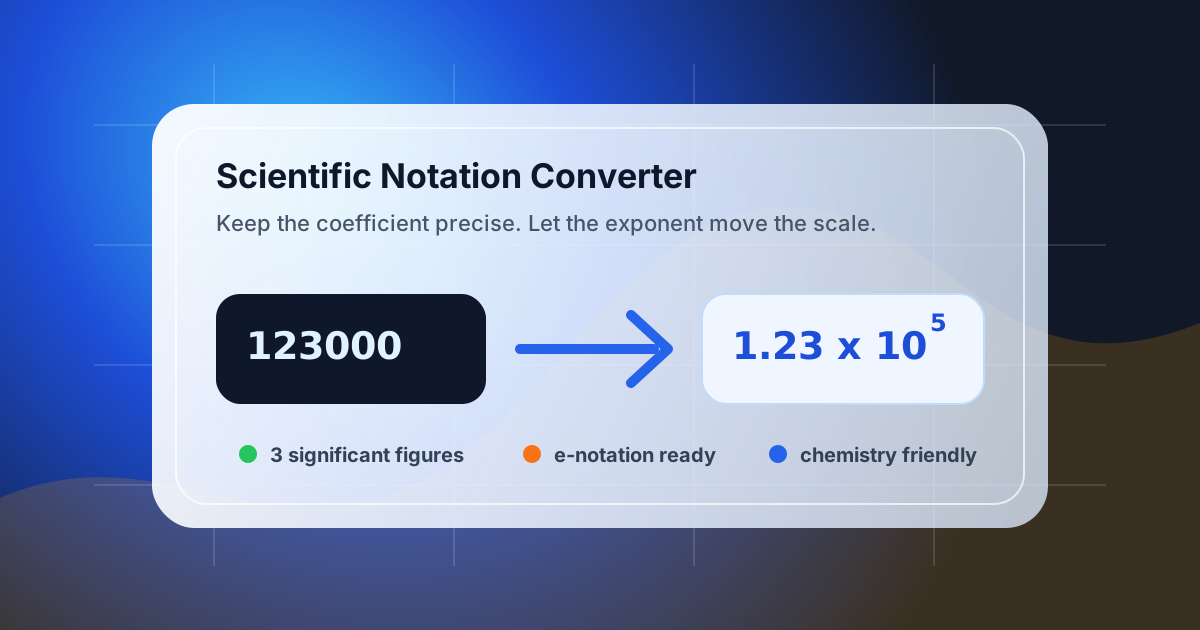
In scientific notation, significant figures are counted in the coefficient only. The power of ten tells you where the decimal point belongs, but it does not add significant figures.
Quick rule
Count the digits in the coefficient. Ignore the x 10 part, ignore the exponent, and keep any trailing zeros that appear after a decimal point in the coefficient.
Fast examples
The coefficient 1.00 has three significant digits.
E notation uses the same rule as x 10^n notation.
The exponent 23 is not counted as a significant figure.
Only the digit 1 appears in the coefficient.
How to count sig figs in scientific notation
Scientific notation separates precision from scale. The coefficient records the measured digits. The power of ten shifts the decimal point so the value stays correct.
Look at the coefficient
In a value like 4.50 x 10^-3, the coefficient is 4.50. This is the only part you use for the sig fig count.
Ignore the power of ten
The 10 and exponent move the decimal point. They change the scale of the number, not the precision of the measurement.
Apply the normal sig fig rules
Non-zero digits count, zeros between significant digits count, and trailing zeros after a decimal point in the coefficient count.
Keep zeros that show precision
If the coefficient is 1.00, both zeros are significant. Dropping them changes the communicated precision.
Scientific notation sig fig chart
Why scientific notation helps with 100 and 1000
Whole numbers with trailing zeros are often unclear. The value 1000 could be rounded to the nearest thousand, or it could be a measured value known more precisely. Scientific notation lets the coefficient show the intended precision.
Plain trailing zeros in a whole number are ambiguous placeholders.
The coefficient contains only 1.
The coefficient 1.0 keeps one decimal trailing zero.
The coefficient 1.00 shows two measured trailing zeros.
The coefficient includes four significant digits.
E notation follows the same rule
Calculators and spreadsheets often write scientific notation with E. Read E as "times ten to the power of." The significant figures still come only from the coefficient before E.
When to use this in homework, labs, and calculators
Chemistry lab result
Use scientific notation to preserve the final zero and show three sig figs.
Large measured count
Use 2.30 to show that the measurement was reported to three significant figures.
Calculator output
Read E23 as x 10^23 and count the coefficient 6.02.
Common mistakes
Counting the exponent as a significant figure.
Dropping trailing zeros from the coefficient and losing precision.
Treating 1000, 1.0 x 10^3, and 1.00 x 10^3 as if they communicate the same precision.
Counting leading zeros in a small decimal before converting it to scientific notation.
Rounding intermediate values too early before the final sig fig rule is applied.
Scientific notation FAQ
Do you count the exponent as a significant figure?
No. In scientific notation, the exponent is not counted as a significant figure. Count only the digits in the coefficient, such as 1.00 or 6.022.
How many significant figures are in 1.00 x 10^3?
1.00 x 10^3 has 3 significant figures. The coefficient is 1.00, and the two zeros after the decimal point are significant.
Is 3.20e4 the same as 3.20 x 10^4 for sig figs?
Yes. 3.20e4 and 3.20 x 10^4 mean the same value and have the same significant figure count. The coefficient 3.20 has 3 significant figures.
Why use scientific notation for 1000?
Scientific notation removes the ambiguity in trailing zeros. Plain 1000 is usually read as 1 significant figure, while 1.0 x 10^3, 1.00 x 10^3, and 1.000 x 10^3 clearly show 2, 3, and 4 significant figures.
Does scientific notation change the number of significant figures?
No. Rewriting a number in scientific notation should preserve the intended precision. It makes the precision easier to see because all significant digits are in the coefficient.